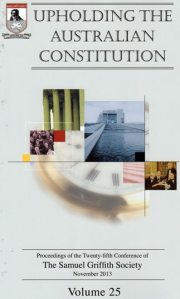
The 25th volume of Upholding the Australian Constitution has just been released to members of the Samuel Griffith Society. This volume, which records the proceedings of the 25th conference held in Sydney, New South Wales, in 2013, has been significantly delayed by the Society. Regrettably, members have not been informed the reasons for the delay, however an accompanying note apologizes for the delay and assures members of the Society that volumes 26 and 27 will be mailed “soon.” The papers which were presented at the 2013 conference include:
- Greg Craven, “A Federalist Agenda for the Government’s White Paper”
- Anne Twomey, “Money Power and Pork-Barreling: Expenditure of Public Money Without Parliamentary Authorisation”
- Keith Kendall, “Comparative Federal Income Tax”
- J. B. Paul, “Independents and Minor Parties in the Commonwealth Parliament”
- Ian McAllister, “Reforming the Senate Electoral System”
- Malcolm Mackerras, “Electing the Australian Senate: In Defence of the Present System”
- Gim del Villar, “The Kable Case”
- Nicholas Carter, “The Human Rights Commission: a Failed Experiment”
- Damien Freeman, “Meagher, Mabo and Patrick White’s tea-cosey – 20 Years On”
- Dean Smith, “Double Celebration: The Referendum that did not Proceed”
- Bridget MacKenzie, “Rigging the Referendum: How the Rudd Government Slanted the Playing Field for Constitutional Change – The Abuse of the Referendum (Machinery Provisions) Act“
- The Hon. Garry Johns, “Recognition: History, Yes. Culture, No”
The volume of UAC was also delivered to members of the Society with a short pamphlet concerning the possible future reforms of the Commonwealth Constitution. The pamphlet, which was published by the Institute of Public Affairs, outlines the case for the removal of section 25 and section 51(xxvi) of the Constitution and the case against the following additional proposals:
- The addition into the Constitution of a preamble or section which states that Aboriginal or Torres Strait Islander people were the first occupants of Australia.
- The addition into the Constitution of a section allowing the Commonwealth government to make laws that only apply to Aboriginal or Torres Strait Islander people.
- The addition into the Constitution a new section prohibiting “discrimination” by a Commonwealth, state or territory government on the basis of an individual’s race or ethnic origin.
- The enshrining by Constitutional provision of an advisory body of Aboriginal or Torres Strait Islander people.
- The reservation of seats in the Commonwealth Parliament for Aboriginal or Torres Strait Islander representatives.
- A treaty recognising the soverignty of Aboriginal or Torres Strait Islander people.
Our colleagues overseas often ask us about the vicissitudes of Australian law reform, particularly where the highest laws intersect with contemporary political controversy. The papers presented at the Samuel Griffith Society provide the best analytical record of legislative and constitutional history. For more information about the Society and its official record of proceedings, Upholding the Australian Constitution, readers are encouraged to contact the Society directly.
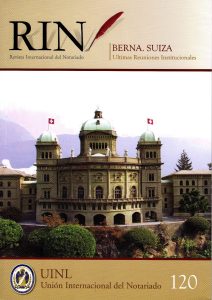 The 120th issue of the Revista Internacional del Notariado, published by the Unión Internacional del Notariado (International Union of Notaries) has been released. The issue contains an editorial by Águeda L. Crespo, the president of the Permanent Notarial Office for International Exchange (ONPI) for the legislature of 2014-2016 and an introductory comment by Daniel-Sédar Senghor, the president of the International Union of Notaries.
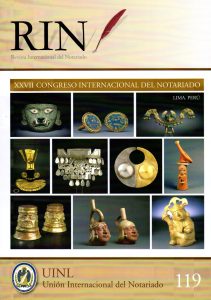 The 119th issue of the Revista Internacional del Notariado (RIN), published by the Unión Internacional del Notariado (International Union of Notaries) has been released. This current issue contains the last message form the president/director of the editorial committee Leon Hirsch in the present legislature term. He writes that:
 Notarial Services (Sydney)
You must be logged in to post a comment.